

The Hidden Cost of Complexity: How It Disguises Itself as Inconsistency
In my previous article, I argued that innovation rarely fails because innovation is the problem. It fails because organizations introduce new complexity before their systems are ready to absorb it.
The natural follow-up question is: How do you know when a system is no longer absorbing complexity effectively?
The answer is deceptively simple.
Operational complexity rarely announces itself as complexity.
It shows up as inconsistency.
Leaders don’t wake up one morning and decide to create operational drag. Complexity accumulates gradually. One exception. One workaround. One additional support request. One process layered on top of another. By the time leadership recognizes the issue, the problem is rarely complexity itself.
It’s inconsistency.
Inconsistent results.
Inconsistent execution.
Inconsistent support.
Inconsistent outcomes.
The challenge for emerging franchise systems is that these inconsistencies often appear long before leaders recognize them as symptoms of a larger structural issue.
Operational complexity doesn't appear all at once.
It follows a recognizable pattern.
If left unresolved, one signal naturally leads to the next.
Over time, I've found these symptoms tend to cluster into three broader patterns: Variability, Replicability Failure, and System Strain. The six signals below provide leaders with practical ways to recognize where their organization may already be experiencing each of these patterns.
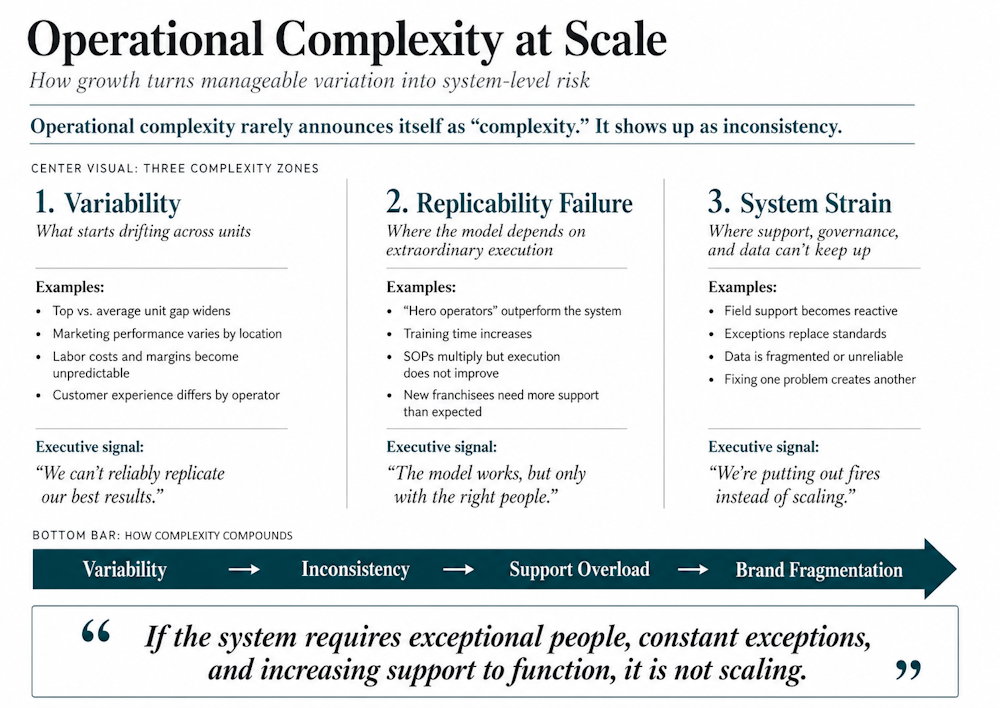
Signal #1: Unit-to-Unit Variability
One of the earliest signs of operational complexity is widening variability between locations.
The brand name is the same. The operating model is the same. The training program is the same. Yet some locations continue to outperform while others struggle to achieve similar results.
Leadership often responds by studying the top performers and asking:
“Why can’t we replicate our best locations?”
The better question may be:
“Why is the system producing such different outcomes in the first place?”
Some variability is inevitable. Markets differ. Operators differ. Customers differ. But when the gap between top-performing and average-performing locations continues to widen, it often becomes a signal that success depends on local adaptation rather than system design.
The system is no longer producing consistent outcomes.
Signal #2: Hero Operator Dependency
Across nonprofit operations, franchised retail locations, and emerging franchise systems, I have repeatedly observed the same pattern.
A small number of exceptional operators consistently outperform everyone else.
Leadership celebrates these individuals as proof that the model works.
Over time, however, a more difficult question emerges:
Would the average operator achieve similar results under the same conditions?
If the answer is no, the organization may not have a talent advantage. It may have a system dependency.
During my years overseeing operations of The UPS Store locations, performance differences were often attributed to operator capability. While capability certainly mattered, the larger question was whether the system could consistently produce strong results without extraordinary intervention.
When performance depends heavily on the judgment, relationships, experience, or problem-solving ability of a specific individual, the location may be succeeding, but the model may not be scalable.
A hero operator is often inconsistency wearing a name tag.
Signal #3: Exception Creep
Most systems do not abandon standardization all at once.
They lose it one exception at a time.
A franchisee requests a unique marketing approach.
Another requests a different staffing model.
A third receives special treatment because their circumstances are “different”.
Each decision feels reasonable in isolation.
Over time, however, exceptions begin replacing standards.
Leadership starts saying:
“Every situation is different” or “We (corporate) don’t understand their market!”
At that point, the organization is no longer managing a system. It is managing a collection of individual situations.
Franchisors often underestimate both the immediate cost of exception management and the long-term const of inconsistency. Every exception creates additional complexity, increases support requirements, and makes it harder to maintain a consistent brand experience.
Some exceptions are unavoidable. Municipal regulations, landlord requirements, or local ordinances may necessitate accommodations.
The challenge arises when exceptions become precedent.
I've seen exception requests consume days of executive time across directors, VP’s, the C-Suite, and franchisees. Conservatively, a single exception can cost a franchisor several thousand dollars in management attention before implementation costs are even considered.
More importantly, exceptions rarely remain isolated. Franchisees communicate with one another. What begins as a one-time accommodation can quickly become an expectation.
Each new exception rarely replaces the old process. It sits alongside it, creating another variation the organization must remember, support, train, and enforce.
Over time, the organization finds itself managing dozens of variations that were never intended to become part of the operating model.
Left unchecked, these inconsistencies become embedded in the operating model, making the system progressively harder to govern, support, and replicate.
The direct cost is measurable.
The long-term cost is complexity.
Eventually, inconsistency stops being the symptom. It becomes the operating model.
Signal #4: Support Strain
One of the most common misconceptions in franchising is that support can compensate for poor franchisee selection.
It cannot.
Support teams can accelerate learning. They can reinforce standards. They can help operators navigate challenges.
What they cannot do is create motivation, discipline, business judgment, or accountability where those characteristics do not already exist.
As systems grow, many franchisors quietly transfer the consequences of weak franchisee selection decisions onto field support teams. Franchise Business Consultants are expected to rescue struggling operators, resolve recurring performance issues, and maintain relationships while avoiding difficult conversations.
Every hour spent compensating for poor fit is an hour not spent improving the broader system.
Eventually, support becomes reactive because it is carrying responsibilities it was never designed to own.
At that point, the issue is not support capacity.
It is system design.
Signal #5: Complexity Compounding
One of the most frustrating symptoms of operational complexity is the feeling that the organization is working harder while making less progress.
More SOPs.
More tools.
More meetings.
More processes.
Yet execution becomes slower and more difficult.
Leaders often describe it this way:
“We’ve added a lot, but it feels harder to run than it used to.”
Or:
“Every time we solve one problem, another one appears.”
What is actually happening is that the system is becoming more interconnected than understood.
A change in marketing affects operations.
A pricing adjustment affects labor.
Technology decisions impact training and support.
I've watched leadership teams solve one legitimate business problem after another, only to discover that the cumulative effect made the organization harder to operate.
Marketing wanted more flexibility, so additional campaign options were created.
Operations needed better consistency, so new SOPs were written.
Technology implemented another platform to improve reporting.
Training expanded to teach the new processes.
Support developed additional tools to answer new questions.
Each decision made sense on its own.
No one intended to make the organization more complicated.
Collectively, they created a system that required more meetings, more approvals, more training, and more coordination simply to produce the same outcome.
No single decision caused the complexity.
It was the accumulation of well-intentioned decisions that were never evaluated as an interconnected system.
That's complexity compounding.
Complexity rarely arrives as a single decision. It arrives as hundreds of reasonable decisions that were never designed to work together.
Signal #6: Data Fragmentation
One of the clearest signs that complexity has outgrown the system is when leadership begins questioning the data instead of discussing the business.
Marketing has one dashboard.
Operations has another.
Finance produces different numbers.
Franchise Development reports something else entirely.
Everyone has data.
Everyone believes they're right.
Yet executive meetings become less about making decisions and more about determining which numbers are correct.
I've watched leadership teams spend an hour reconciling reports before they could spend ten minutes discussing strategy.
At that point, the issue is no longer technology.
It is organizational confidence.
When leaders lose confidence in the information they're using, decision-making slows. Priorities become reactive. Resources are allocated based on assumptions rather than evidence.
The system is no longer generating clarity.
It is generating competing versions of reality.
One of my favorite executive sayings is: "If every department has its own version of the truth, leadership has no truth."
Every function was optimizing its own metrics.
Marketing optimized leads.
Development optimized franchise sales.
Operations optimized compliance.
Finance optimized margins.
Support optimized response times.
Individually, every department improved.
Collectively, no one could explain whether the system itself was healthier.
That's fragmentation.
Data fragmentation isn’t an IT problem. It’s a governance problem.
Data doesn't become fragmented because organizations lack reports. It becomes fragmented because organizations lack alignment around what they're trying to measure.
If leadership hasn’t agreed on:
What success looks like.
Which metrics matter most.
Who owns them.
And, how they connect.
Then every dashboard simply becomes another opinion.
Closing
Leaders often assume complexity announces itself through larger organizational charts, more meetings, or thicker operations manuals.
In reality, complexity usually appears much earlier.
It shows up as inconsistent results.
Inconsistent execution.
Inconsistent support.
Inconsistent outcomes.
By the time those inconsistencies become visible, complexity is already inside the system.
The question is not whether growth creates complexity.
The question is whether the system can absorb it.
Because if a system requires exceptional people, constant exceptions, and increasing support to function, it is not scaling.
It is relying on effort instead of design.