

Growth is exposing the system.
Find where it breaks before it gets expensive.
The Inflection Alignment Diagnostic identifies where growth is outpacing structure across unit economics,
operations, marketing, and capital so you can see what is actually happening beneath the surface.
If growth feels heavier than it should, the system isn’t built to carry it.
For franchise systems where growth is starting to feel harder than it should.
More growth shouldn’t create this much friction.
At a certain point, growth stops feeling like momentum and starts feeling like strain.
More locations. More operators. More variability. More decisions. More support demands.
What used to feel manageable starts to feel inconsistent. Performance gaps widen. Support teams get pulled into firefighting. Operators feel the strain before leadership can fully explain it.
In many emerging franchise systems, this is not a marketing problem or an operations problem in isolation. It is a system design problem. As your own positioning states, strong franchise brands do not just scale locations. They scale support infrastructure. The structural decisions underneath the model determine whether growth creates durable enterprise value or accumulates operational risk.
The cost isn’t always immediate. It shows up in slower decision-making, inconsistent performance, operator frustration, and support teams stretched beyond capacity.
And over time, it compounds.
Common patterns we see in growing systems
Strong top-line growth, but inconsistent unit performance
Increasing support demands without clear structure
Marketing that drives activity, but not predictable outcomes
Operators experiencing different levels of success
Leadership making more decisions, but with less clarity
If several of these feel familiar, your system may be under more strain than it appears.
Who the Diagnostic is for
This diagnostic is designed for founder-led and growth-stage franchise systems asking questions like:
“Why does everything feel harder as we grow?”
“Why is performance inconsistent across operators or locations?”
“Why is support getting stretched faster than expected?”
“Why do we have momentum, but not predictability?”
“Are we building something that can actually scale well?”
Most teams reach for this when growth still looks strong, but feels harder than it should.
It is often used when systems are entering a new phase of growth or trying to stabilize after expansion.
So what is actually driving that strain?
What the Diagnostic evaluates
The Diagnostic identifies where your system is carrying more than it was designed to support.
Unit
Economics
Does the model support healthy operator outcomes and repeatable growth?
Return profile, cost structure, and margin dynamics, tested for real-world scalability.
Operational Complexity
Can the concept be executed consistently as the system grows?
Where complexity is created, where it’s absorbed, and whether the model holds under scale.
Marketing Discipline
Is demand generation structured, measurable, and aligned with the model?
How demand is created, measured, and whether results are predictable.
Capital
Alignment
Is the financial structure supporting growth, or working against it?
Whether investment, support capacity, and growth expectations are truly aligned.
This is where the system starts to feel the strain.
How strain builds across the system
Strain doesn’t originate from a single issue.
It compounds across the system.
As growth accelerates, pressure moves through unit economics, operations, marketing, and capital, often in ways that aren’t immediately visible.
System Strain Map™ (Inflection Alignment)
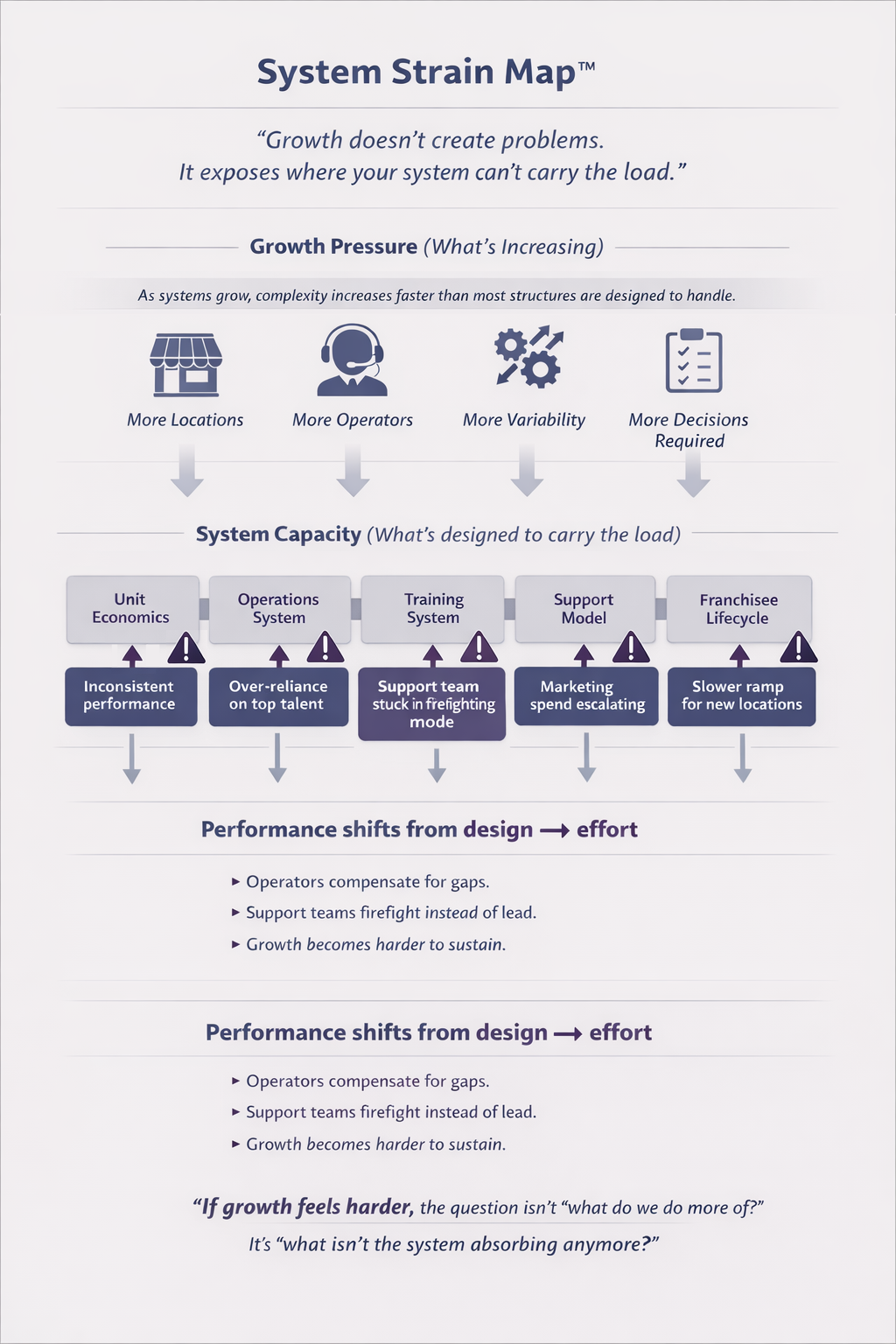
Performance shifts from design → effort.
When systems are aligned, performance is driven by structure.
When they’re not, performance depends on individual effort to compensate.
That’s when growth starts to feel heavier than it should.
This is the point where most systems need clarity, not more effort.
What a good diagnostic changes
A strong diagnostic does not just tell you what is wrong. It helps you name the real problem accurately.
It surfaces what is not obvious, where symptoms are being caused by something upstream in the system.
That matters because most emerging systems do not fail from lack of effort. They fail because growth outpaced the design choices underneath it.
The goal is clearer decisions, better prioritization, and a stronger understanding of whether the system is being asked to carry more than it was designed to support.
Why Inflection Alignment
Most diagnostics isolate one problem.
This one shows how problems compound across the system.
It looks at how unit economics, operations, marketing, and capital interact under real growth pressure, and where that interaction starts to break.
Erika C. Spalding brings experience across marketing, operations, and governance, with a focus on how systems actually perform as they scale. She has worked inside environments where unit level outcomes, support capacity, and growth decisions are directly connected.
This perspective surfaces what is not obvious. Symptoms in one part of the system are often caused by something upstream.
This is not theory. It comes from working inside systems where growth, performance, and support capacity are directly connected, and where misalignment creates real operational strain.
What you receive
The Diagnostic results in a clear readout of where your system is under strain, and what needs to change first.
It is designed to give leadership a sharper picture of what is actually happening beneath the surface.
The Diagnostic produces:
• A focused assessment of the system’s current strain points
• A clear view of where growth is outpacing infrastructure
• Pattern recognition across economics, support, marketing, and execution
• A practical readout of likely risk areas and capability gaps
• A clear set of priorities for what needs attention first, and what can wait
This is not a generic audit. It is a strategic diagnostic designed to show where the model is holding, where it is fragile, and what that means for the next phase of growth.
Clients leave with a clear understanding of what is actually driving performance, and what needs to change first.
If growth is starting to rely more on effort than design, it’s time to understand why.
See what your growth is revealing—before it becomes expensive to fix.
If the system feels heavier than it should, the Diagnostic helps you understand why. Left unaddressed, this kind of strain compounds, making growth slower, less predictable, and more expensive to support.
Request the Inflection Alignment Diagnostic to identify where structure, support, economics, and growth may be out of alignment.
Request the Diagnostic
If this feels familiar, the next step is to make the system visible.
For franchise systems that need a clearer picture of where growth is creating strain. Share a few details about your brand, and we’ll follow up about fit, scope, and timing.
For franchise systems where growth is starting to feel harder than it should.
A limited number of diagnostics are scheduled each month to ensure depth and focus.