

Clarity Before Complexity: Why Innovation Fails When the System Isn’t Ready
Innovation is one of the easiest words to overuse in a growing company.
It sounds strategic. It signals momentum. It gives leaders something exciting to point to when the core business starts to feel heavier, messier, and harder to manage than it once did.
A new product.
A new partnership.
A new technology layer.
A new revenue stream.
A new customer experience.
On the surface, these additions can look like progress.
But in a growing franchise system, innovation has a different test.
Innovation does not fail because leaders lack ideas. It fails when new ideas are introduced before the organization has the clarity, capacity, and discipline to absorb them.
The question is not simply whether the idea is good.
The question is whether the system is ready to carry it.
Because when a franchise system is still clarifying its operating model, training pathway, field support cadence, brand standards, customer experience, and unit-level economics, additional complexity does not create leverage.
It creates load.
And that load rarely stays at headquarters.
It moves downstream.

In franchising, innovation must follow system readiness. When it doesn’t, complexity gets transferred downstream to the franchisee.
It shows up in franchisee confusion. In inconsistent execution. In uneven customer experiences. In support teams answering questions that should have been solved by the system. In operators trying to interpret a moving target while also protecting their own capital, labor, reputation, and time.
That is why innovation does not fail only because the idea was wrong.
Sometimes innovation fails because it arrived too early.
Innovation is powerful only when the core system is stable enough to carry it.
Complexity is not the enemy.
Premature complexity is.
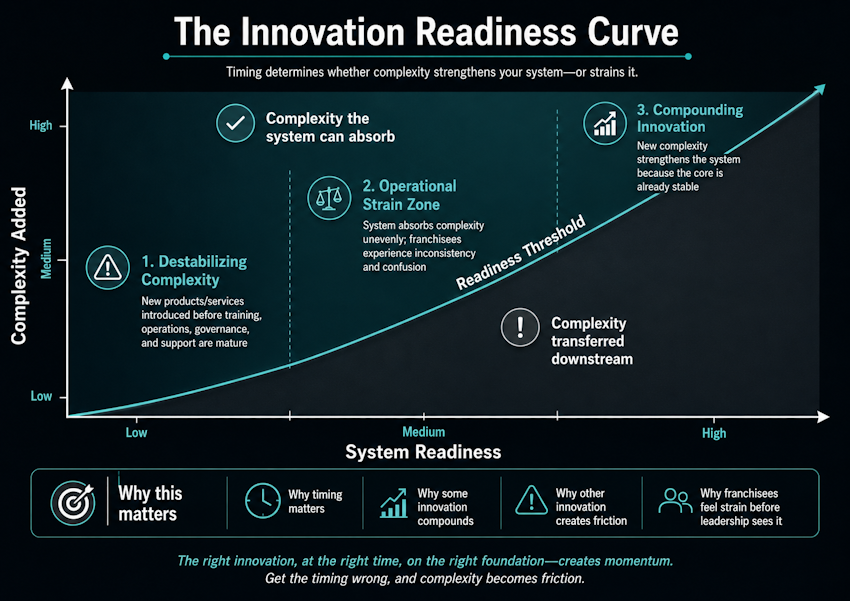
Unfinished systems do not scale. They shift risk.
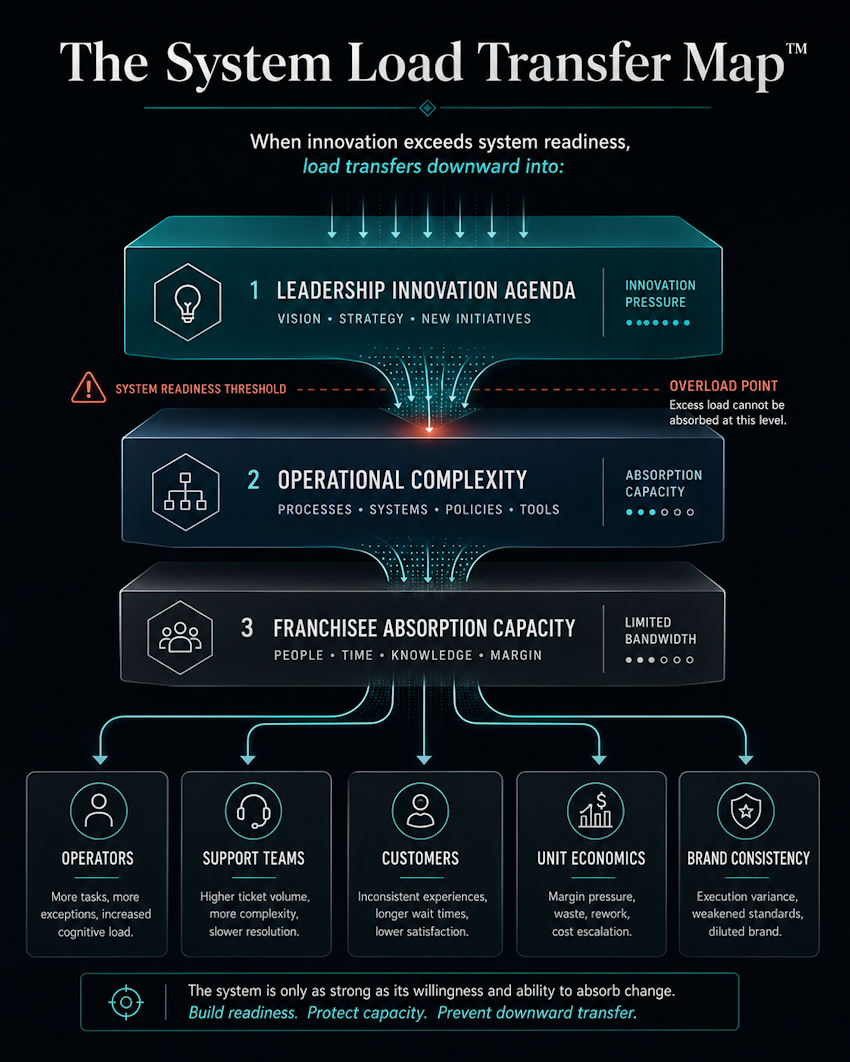
Healthy systems do not reject innovation. They sequence it. They understand that operational maturity determines whether complexity becomes leverage—or operational drag.
Questions Leaders Should Ask Before Adding Complexity
Before introducing new products, partnerships, technologies, or revenue streams, leadership teams should ask:
1. Are we adding complexity because the system is ready—or because the current system feels difficult?
2. Would franchisees describe the current operating model as clear and repeatable?
3. If this initiative succeeds, does the system currently have the infrastructure to support it consistently across locations?
4. Are we solving a validated operational problem—or chasing novelty?
5. Are we building additional sails while the hull is still under construction?
Leadership discipline is often revealed less by the ideas an organization pursues than by the complexity it chooses to delay.