

The 15–30 Unit Trap
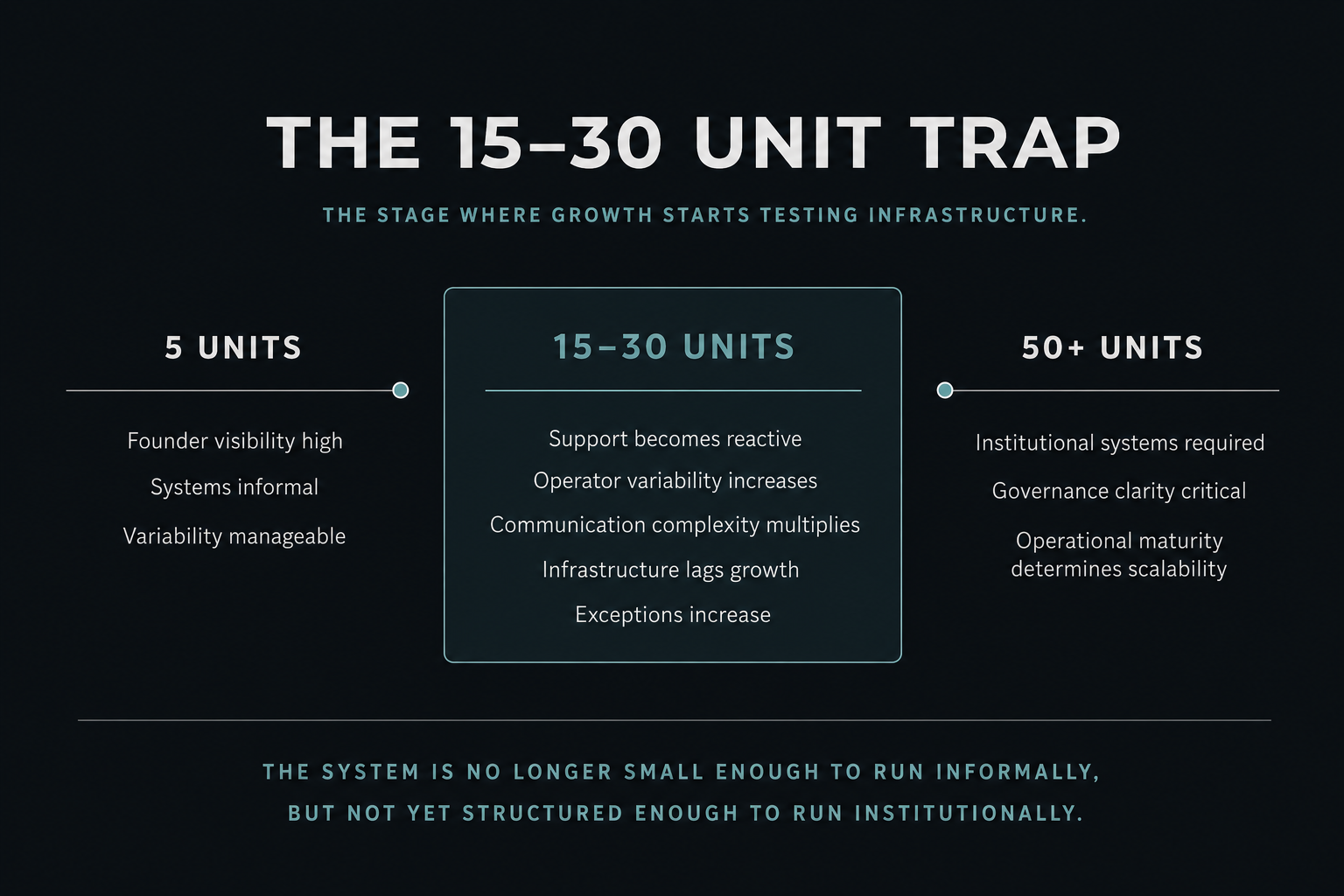
Most franchise systems do not break at 2 locations.
And they do not usually break at 200.
They begin to strain somewhere in the middle.
Usually somewhere between 15 and 30 units.
Not because growth is the problem.
Because complexity starts increasing faster than the system was designed to support.
The Stage Where Complexity Starts Compounding
At this stage, growth still looks like progress from the outside.
More locations.
More operators.
More activity.
But internally, something starts to change.
Founder visibility starts disappearing. Operator variability increases. Support becomes reactive. Communication complexity multiplies. Informal systems stop scaling. Exceptions increase. Infrastructure begins lagging growth.
What once felt manageable starts becoming inconsistent.
Performance varies more from location to location. Support becomes reactive instead of structured. Marketing results become uneven. Onboarding quality drifts.
None of this feels like failure.
It feels like complexity.
And that is what makes it dangerous.
The Difference Between Momentum and Operational Maturity
Most brands interpret this stage incorrectly.
They assume they need:
more support
more marketing
more infrastructure
more people
more effort
So they add.
But the issue usually is not capacity.
It is alignment.
Because revenue is often still growing, leadership assumes the system is healthy. But growth can temporarily mask structural weakness.
A system can still be expanding while operational discipline quietly deteriorates underneath it.
The system is no longer small enough to run informally, but not yet structured enough to run institutionally.
When Small Gaps Become Structural Problems
At 5 units, a system can still work even if it is imperfect.
At 20, those imperfections compound.
What was once a small operational gap becomes a structural issue:
unit economics no longer hold consistently
operational execution varies
onboarding quality drifts
communication complexity multiplies
the model works in some markets, but not others
This is where growth starts revealing whether the system is repeatable—or simply functioning.
Most brands do not recognize the 15–30 unit stage as a structural inflection point.
They treat it like a temporary phase.
So they push through it.
And that is often when the system starts to strain.
The Real Question
At this stage, the question is no longer:
“How do we keep growing?”
It becomes:
“Is this model actually built to scale beyond this point?”
That is a different question.
And answering it usually requires more than adding effort.
It requires redesign.
Responsible expansion eventually requires:
support architecture
governance clarity
operational discipline
field capacity planning
onboarding consistency
decision-right clarity
performance visibility
Because growth does not automatically scale infrastructure.
Most systems do not break immediately.
They reveal themselves at scale.
And the 15–30 unit stage is where growth stops being proof of concept and starts becoming a test of infrastructure.