

The Real Reason Performance Varies Across Locations
Same brand. Same model. Completely different outcomes.
One location is thriving.
Another is struggling.
A third is barely holding on.
Same playbook. Same training. Same brand name on the door.
So what’s going on?
Most teams default to the same explanation:
“It’s the operator.”
“They’re just not executing.”
“Some people are better than others.”
Sometimes that’s true.
But when performance varies consistently across locations, you’re not looking at a people problem.
You’re looking at a system signal.
Variability Is Not Random
If outcomes were driven primarily by operator talent, you’d expect some variation.
But not this much.
Not:
Top performers significantly outperforming the average
Mid-tier operators struggling to stay profitable
New locations taking wildly different paths
That kind of spread isn’t normal.
It’s diagnostic.
It’s telling you something about how your system actually works.
More specifically:
It tells you the system only works under certain conditions.
A Model Is Not a System
This is where most brands get stuck.
They validate the model:
“This works.”
“We have profitable locations.”
“We’ve proven the concept.”
And they’re right.
But a working model is not the same as a scalable system.
A model proves it can work.
A system ensures it works, without relying on perfect conditions.
When performance varies widely, what you actually have is:
A model that works…selectively.
What Variability Is Really Telling You
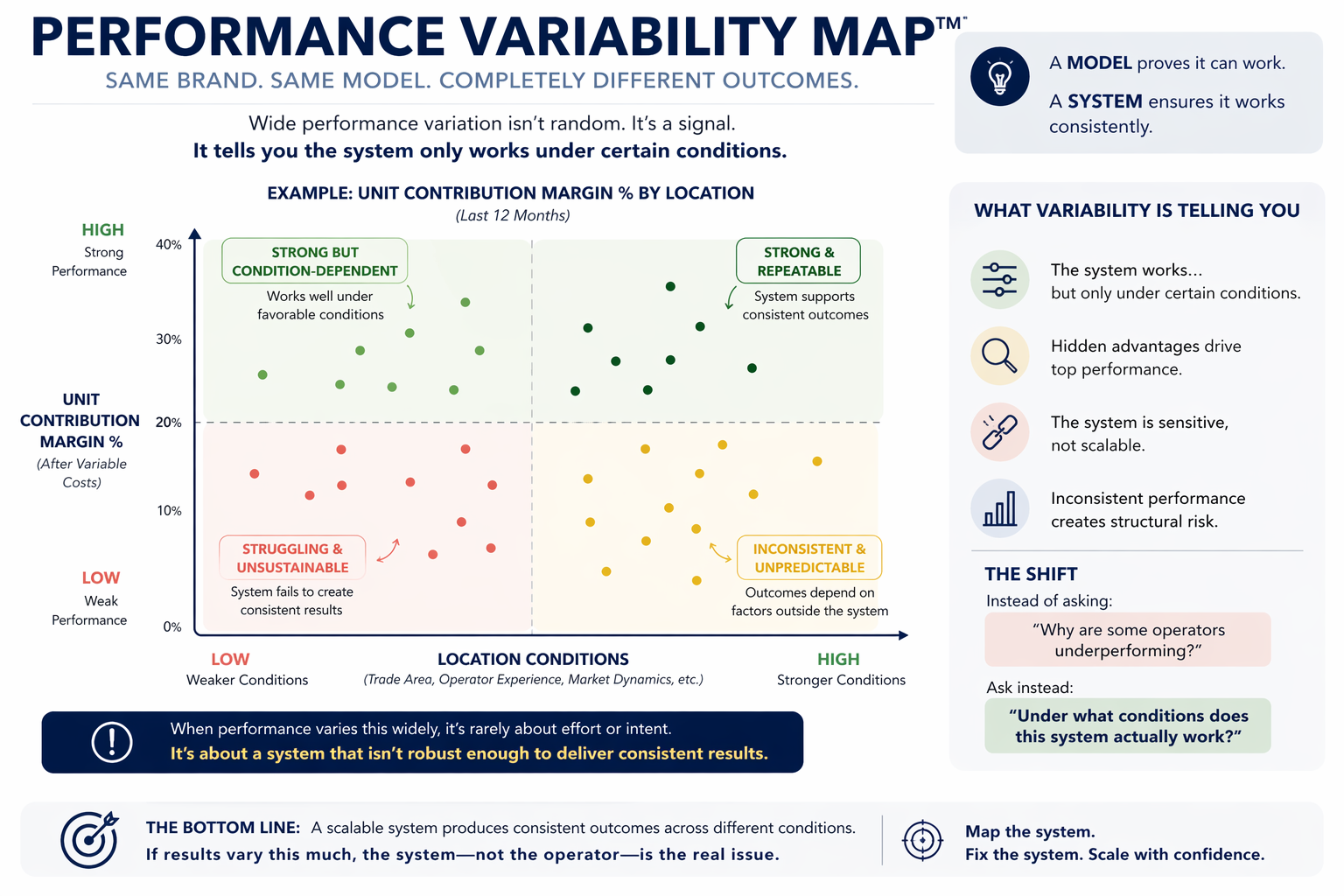
When you zoom out, patterns start to emerge.
Top-performing locations often share hidden advantages:
Stronger trade areas
More experienced operators
Favorable early ramp conditions
Struggling locations often aren’t doing anything wrong.
They’re just operating without those advantages.
Which means the system isn’t robust enough to produce consistent outcomes.
It’s sensitive.
Fragile, even.
Small changes in conditions create outsized differences in outcomes.
Why This Matters More Than It Seems
Inconsistent performance isn’t just an operational issue.
It’s a structural risk.
It:
Makes support harder to scale
Erodes confidence across the network
Weakens unit-level economics
Impacts long-term valuation
Because:
Predictable systems scale.
Unpredictable ones stall.
The Shift Most Teams Need to Make
Instead of asking:
“Why are some operators underperforming?”
Ask:
“Under what conditions does this system actually work?”
That’s where the real answer is.
A Quick Diagnostic Lens
If performance varies across your locations, pause and ask:
Are top-performing locations benefiting from conditions others don’t have?
If a new operator followed your system exactly, would they produce similar results?
Do struggling locations lack effort—or are they operating within a harder version of the model?
Can you clearly explain why top locations outperform—in a way that can be replicated?
If you removed your top 20%, would the system still look healthy?
Is success driven more by who and where… or by how the system works?
If those answers are unclear—or inconsistent—
You’re not looking at isolated performance issues.
You’re looking at a system that works…
but only under certain conditions.
Closing
When outcomes vary, it’s easy to look at the operator.
But variability at scale is rarely about effort or intent.
It’s about structure.
And structure determines whether a system produces consistent results,
or depends on the few who can make it work anyway.
When outcomes vary, it’s usually not the operator.
It’s the system.
If you’re seeing this pattern in your system, the next step isn’t more effort, it’s better diagnosis.
This is exactly the kind of signal I help leadership teams unpack before growth compounds risk.