

Capacity Is Not Demand: How Growth Signals Get Mistaken for Market Validation
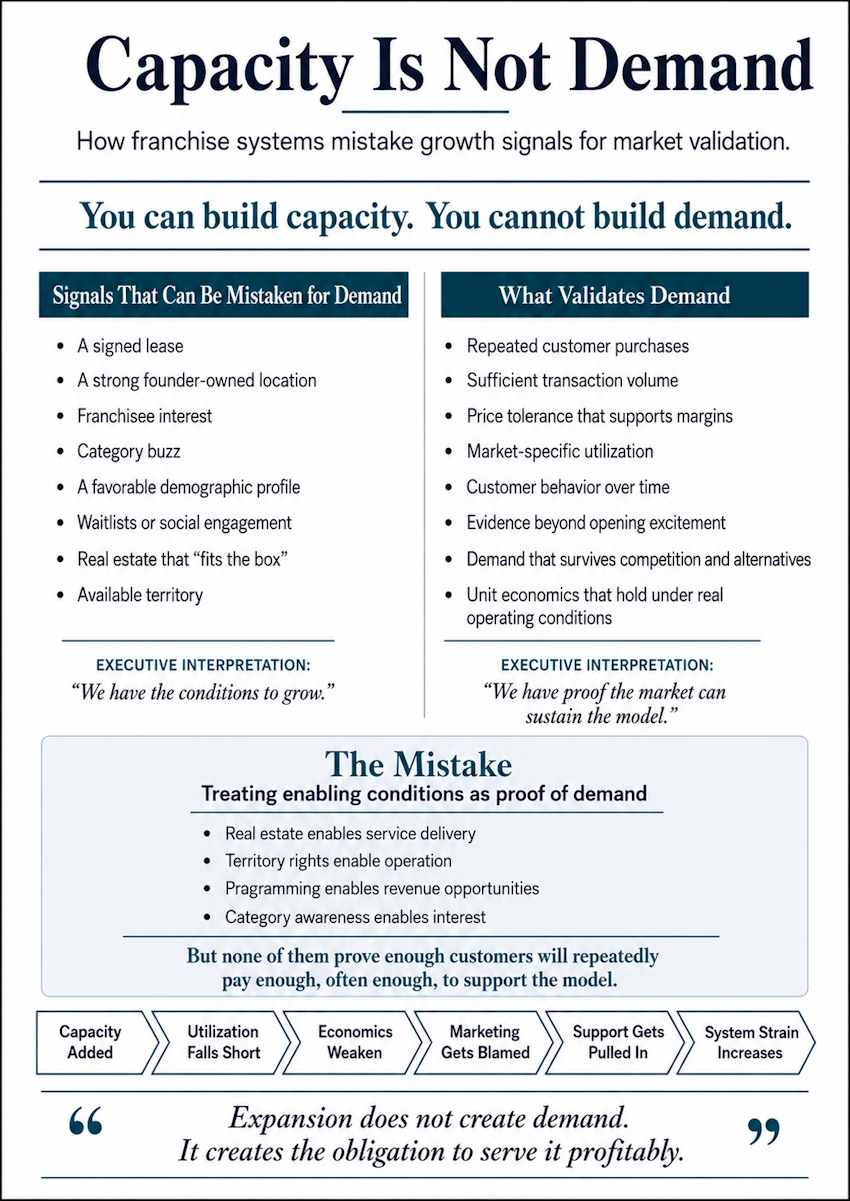
Capacity gets overbuilt when the franchise ecosystem treats real estate availability, franchisee interest, category momentum, and early-unit success as substitutes for validated customer demand.
A market can look attractive and still fail to produce enough recurring demand to support the capacity the system added.
That is one of the most expensive assumptions an emerging franchise system can make.
I have heard versions of this assumption expressed many ways:
“The box works.”
“We just need more locations.”
“If we can secure the real estate, we should build it.”
“If franchisees are buying territories, customers must be there.”
On the surface, these sound like growth decisions.
In reality, they are demand assumptions.
Capacity and demand are often treated as interchangeable.
They are not.
Capacity is what your system is capable of serving.
Demand is what the market is actually willing to buy.
The two are related, but they are not the same thing.
You can build capacity.
You cannot build demand.
Capacity includes the physical, territorial, programming, and operating footprint the system adds in expectation of demand. It can take the form of a location, square footage, courts, service bays, production space, territory rights, operating hours, programming volume, staffing assumptions, or real estate commitments.
When leaders confuse capacity with demand, they do not just overbuild. They misallocate capital, stretch operational resources, weaken unit economics, and create downstream complexity that no amount of marketing or support can fully overcome.
This is especially dangerous in franchising because the cost of the assumption is often carried by the franchisee first.
The “Box Works” Assumption
In emerging franchise systems, early success can create false confidence.
A founder-owned location performs well.
A flagship unit benefits from strong local relationships, favorable timing, founder involvement, or unusually strong category awareness.
The model appears validated.
Then the organization begins looking for more locations that match the physical profile of the original unit.
The facility fits.
The demographics look attractive.
The lease is available.
The market appears open.
The assumption becomes: if the box works, the site works.
But a site is not a market.
A lease is not demand.
A territory is not utilization.
A franchise sale is not proof that customers exist.
This distinction matters because franchisees are not investing in theoretical capacity. They are investing in a business that must generate enough recurring demand to support the model.
A corporate location may have time to mature, absorb inefficiency, or adjust over a longer horizon.
A franchisee usually does not have that luxury.
Franchisees enter the system with expectations around revenue, cash flow, payback period, and return on investment. If market demand is weaker than assumed, the gap does not remain theoretical for long.
It becomes payroll.
It becomes rent.
It becomes marketing spend.
It becomes frustration.
What the Industry Mistakes for Demand
The franchise industry can over-interpret many signals.
Investor enthusiasm can look like demand.
Franchise sales can look like demand.
A signed lease can look like demand.
Strong early units can look like demand.
Category momentum can look like demand.
Membership interest, waitlists, and social engagement can look like demand.
But none of these automatically prove that enough customers will repeatedly pay at the price point required to support the model.
Franchise demand and customer demand are not the same thing.
A franchise sale may indicate that an investor believes in the concept, the leadership team, the market opportunity, or the brand story. It does not automatically prove that enough customers in a specific market will repeatedly purchase the offering at the price point required to sustain the unit.
This is one of the most dangerous forms of false confidence in emerging systems. The franchisor sees demand for the franchise opportunity and begins to assume demand for the customer experience.
Those are different tests.
This is where franchising can become overly confident in formulas.
A formula may tell leadership how many units a market should support.
It does not prove how many units the market will support.
A certain population count may appear to support a certain number of units.
A certain territory size may appear sufficient.
A certain square footage range may appear appropriate.
A certain support ratio may appear reasonable.
These formulas can be useful starting points, but they become dangerous when they are treated as universal rules.
A market with one million people does not automatically create the same demand for every concept. One million people may support a certain number of sandwich shops, fitness studios, indoor recreation facilities, golf simulators, chicken restaurants, or retail service locations very differently depending on income, traffic patterns, competition, customer behavior, category awareness, price tolerance, and frequency of use.
The issue is not that formulas are useless.
The issue is that formulas are not validation.
They are assumptions that need to be tested against the specific concept, the specific market, and the specific operating model.
The broader ecosystem around franchising can reinforce this confusion.
A real estate broker may correctly identify a vacant big-box space as physically suitable for an indoor recreation concept. The square footage may work. The ceiling height may work. The parking field may work. The visibility may work.
But physical fit is not the same as economic fit.
If the lease cost, buildout requirement, staffing model, and utilization assumptions do not align with the unit economics, the space may create confidence without creating viability.
This is not necessarily because anyone is acting in bad faith. Brokers are often evaluating space through a real estate lens. Franchisees may be evaluating the opportunity through a growth lens. Investors may be evaluating the category through a trend lens. Franchisors may be evaluating the market through an expansion lens.
Each participant may be right about their piece of the opportunity.
The risk emerges when the system treats those partial signals as proof of demand.
A space can be available.
A demographic profile can look attractive.
A category can be growing.
A franchise candidate can be excited.
A broker can make a compelling case.
None of those facts alone prove that enough customers will repeatedly pay enough, often enough, to support the economics of that location.
The industry often mistakes enabling conditions for demand.
Real estate enables demand to be served.
Territory rights enable a franchisee to operate.
Programming enables revenue opportunities.
None of them prove that the market will produce enough paying customers to sustain the model.
Capacity Is Not Always Obvious
Capacity is not always a building, a court, a service bay, or a production line.
Sometimes it is a territory.
In retail service franchises, a protected territory may look sufficient on paper. A few square miles can seem reasonable when mapped against population density, household counts, or traffic patterns.
But a territory defines the area where a franchisee has rights. It does not prove that enough demand exists inside those rights to support the model.
Consider a retail service unit that depends on meaningful transactions, not just foot traffic. If the average qualifying transaction is approximately $30 and the store needs approximately $1.5 million in annual revenue to break even, the unit needs roughly 50,000 qualifying transactions per year.
That means more than 4,000 meaningful transactions per month, or approximately 137 to 160 meaningful transactions every operating day, depending on how many days the store is open.
Those transactions cannot simply be low-value activity that brings people through the door. They have to be real revenue-producing transactions: shipping, printing, mailbox services, and other purchases substantial enough to support the economics of the model.
Now place that store in a market with tens of thousands of residents. On paper, the population may look attractive.
But population is not the same as available demand.
Some residents leave the area during normal business hours. Others use competitors, employer resources, online postage, home printers, or nearby alternatives. Some are only available early in the morning, late in the evening, or on weekends.
The practical customer base is smaller than the population number suggests.
Then add another same-brand location several miles away.
The original territory may still be technically protected, but the practical demand environment has changed. Customers do not behave according to franchise territory boundaries. They choose based on convenience, commute patterns, parking, habits, pricing, and immediate need.
That is where capacity and demand diverge.
The franchisor may have added another unit of capacity.
But it has not necessarily created another 50,000 qualifying transactions of demand.
Interest Is Not Demand
Interest is easy to overestimate.
People may like the idea.
They may attend an event.
They may join a list.
They may say the concept sounds exciting.
But interest is not the same as demand.
Interest is what people say before money changes hands.
Demand is what they do repeatedly after it does.
More specifically, demand requires repeated purchasing behavior at a price that supports the economics of the business.
This distinction becomes especially important in emerging categories.
There is a major difference between selling into an existing market and educating a market that does not yet understand the category.
If customers already understand the need, marketing can focus on differentiation.
Why this brand?
Why this location?
Why this offering?
But if customers do not yet understand the category, marketing has to do something much more expensive.
It has to help create the market.
That requires a different level of investment, time, and risk.
It is also especially important in concepts where customers have free or low-cost alternatives. A person who enjoys an activity or service for free may be interested in a premium paid version. That does not mean they will pay for it consistently.
The question is not simply whether people like the product or service.
The question is whether enough people value it enough to pay for it repeatedly, in that market, at that price, with that competitive landscape.
That is demand.
Without that discipline, organizations can mistake enthusiasm for economics.
Capacity Without Demand Becomes Structural Drag
When capacity is built before demand is validated, the consequences travel through the system.
At the unit level, revenue falls short.
Margins weaken.
Payback assumptions stretch.
Cash flow tightens.
Labor becomes inefficient because the business is staffed for volume that has not materialized.
Employees feel the slowdown.
Customers feel it too.
In some businesses, community itself is part of the product. If there are not enough customers to create energy, participation, or a reliable experience, early adopters may leave before the market ever has a chance to mature.
The business then faces a difficult cycle.
It needs more customers to create the experience.
But the weak experience makes it harder to retain customers.
At that point, underutilized capacity is not unused opportunity.
It is structural drag.
What gets blamed
When demand does not match capacity, organizations often blame the symptoms.
Marketing is not working.
The franchisee is not trying hard enough.
The market is unusual.
Operations needs to improve.
The programming needs to change.
The pricing needs to be discounted.
Corporate does not understand the local market.
Sometimes those issues are real.
Marketing may need improvement. Franchisees may need coaching. Operations may need refinement. Local adaptation may matter.
But in many cases, these are not the root problem.
They are downstream effects of an earlier demand-validation failure.
If the market does not contain enough customers who are willing to pay for the offering at the required price, better collateral will not solve the issue.
More programming will not solve the issue.
More support will not solve the issue.
Discounting may create activity, but it can also weaken the economics the model was built to produce.
This is where leadership discipline matters.
The question should not be, “How do we make this location work at any cost?”
The better question is, “What demand did we believe existed, and what evidence supported that belief?”
The system absorbs the assumption
The danger of confusing capacity with demand is that the consequences do not stay contained.
A weak market does not only affect one location.
It affects the franchisee’s confidence.
It affects marketing priorities.
It affects validation calls with future franchise candidates.
It affects investor confidence.
It affects the credibility of the model.
Once a franchisee begins to underperform, the organization often mobilizes around the problem. Field support gets involved. Marketing creates special campaigns. Operations evaluates execution. Leadership joins calls. Exceptions are considered. New tactics are tested.
The system begins working harder to compensate for a demand assumption that should have been tested earlier.
That is how a market-validation problem becomes an operational problem.
Then a support problem.
Then a governance problem.
Every underutilized unit becomes more than an economic problem. It becomes an operational problem, a support problem, and eventually a governance problem.
What leaders should ask before adding capacity
Before adding capacity, leaders should ask harder questions about demand.
What demand has actually been validated?
At what price?
Over what period of time?
Under what market conditions?
With what marketing investment?
Against what competitive alternatives?
With what operator capability?
What utilization level does the model require to work?
What happens if demand is 20 percent lower than projected?
What happens if the market takes twice as long to mature?
What support will this location, territory, or unit require if it underperforms?
These questions are not meant to slow growth for the sake of caution.
They are meant to protect the system from growth built on assumptions.
Expansion does not create demand.
It creates the obligation to serve demand profitably.
Closing
Capacity is a decision.
Demand is a condition.
Leaders can choose to build locations, sign leases, award territories, add square footage, expand programming, extend operating hours, or increase staffing assumptions.
But the market decides whether that capacity will be used profitably.
When capacity exceeds validated demand, growth becomes a burden the system has to carry.
The first signs may appear at the unit level: underutilization, weak margins, frustrated franchisees, and disappointing cash flow.
But the burden does not stay there.
It moves into the franchisor organization.
When demand falls short, support becomes the shock absorber.
And support capacity is not infinite.