

Support Load Is Not Linear: Why Growing Franchise Systems Miscalculate Support Capacity by Measuring Locations Instead of Complexity
In franchising, one of the most common support-planning assumptions is that one Franchise Business Consultant (FBC) can effectively support roughly 40 franchise locations.
It's simple.
It's familiar
It's easy to budget around.
But in emerging franchise systems, support demand is shaped by complexity, lifecycle stage, operator capability, geography, and growth velocity.
That's why the 1:40 ratio is often a useful shortcut, but an incomplete strategy.
The 1:40 ratio has quietly shaped support staffing decisions for decades because it provides a straightforward answer to a difficult question:
How many Franchise Business Consultants do we need?
But the ratio assumes something that simply isn't true.
It assumes every franchise location requires roughly the same amount of support.
My experience working across emerging and mature franchise systems, as well as my experience as a franchise operator/franchisee, has shown the opposite.
In one system, we operated under an area manager model where one area manager, supported by one other team member, was responsible for roughly 60 locations.
That experience made the limitation of simple support ratios very clear.
The question was not just how many locations one person could "cover."
The real question was how much support load those locations were generating.
Support load is created by complexity, not by unit count.
The 1:40 Rule Isn't Wrong. It's a Shortcut.
To be clear, this isn't an argument that the 1:40 rule is universally wrong.
The rule likely emerged in large, mature franchise systems where operations were highly standardized, franchisees required relatively little ongoing support, and field support processes were well established. In those environments, it may serve as a reasonable budgeting shortcut.
But most emerging franchise systems aren't operating under those conditions.
The problem is when emerging franchise systems adopt the same benchmark without recognizing that they are operating under entirely different conditions.
A mature system and an emerging system may each have forty locations.
That doesn't mean they require the same level of support.
Support capacity is not determined by the number of locations.
It is determined by the support load those locations generate.
The Hidden Variable: Support Load
Every growing franchise system eventually asks the same question:
How many locations can one Franchise Business Consultant support?
It's a reasonable question.
It's also the wrong one.
Because it assumes support demand is determined by the number of locations.
It isn't.
It's determined by support load.
Support load doesn't increase simply because another location opens. It increases because every new source of complexity amplifies the others.
That's an important distinction.
Opening one additional location means another owner, another team, another market, another local marketing plan, another operating environment, another set of questions, another opportunity for inconsistency, and another potential source of exceptions.
Now imagine that location is also:
A first-time franchisee
A new opening requiring intensive onboarding
Located several hours from the nearest market
Experiencing operational challenges
Hiring an entirely new staff
Opening while multiple other locations are launching simultaneously
The additional support required isn't simply additive.
It's multiplicative.
Each complexity factor increases the impact of the others.
Why Support Load Isn't Linear
This is why support capacity rarely scales in a straight line.
Early growth often creates efficiencies.
An FBC can leverage best practices across multiple franchisees. Resources become more standardized. Coaching conversations become more repeatable.
Then the curve changes.
More new openings require additional onboarding.
More struggling operators require deeper coaching.
Geographic expansion increases travel time.
Operational inconsistency creates more exceptions.
Growth accelerates faster than processes mature.
Eventually, the role changes.
Travel increases.
Response times slow down.
Proactive coaching gives way to reactive problem-solving.
Instead of helping franchisees improve performance, the FBC becomes a firefighter, responding to urgent issues instead of preventing them.
The Franchise Business Consultant hasn't become less capable.
The system has simply become more complex than its support capacity was designed to handle.
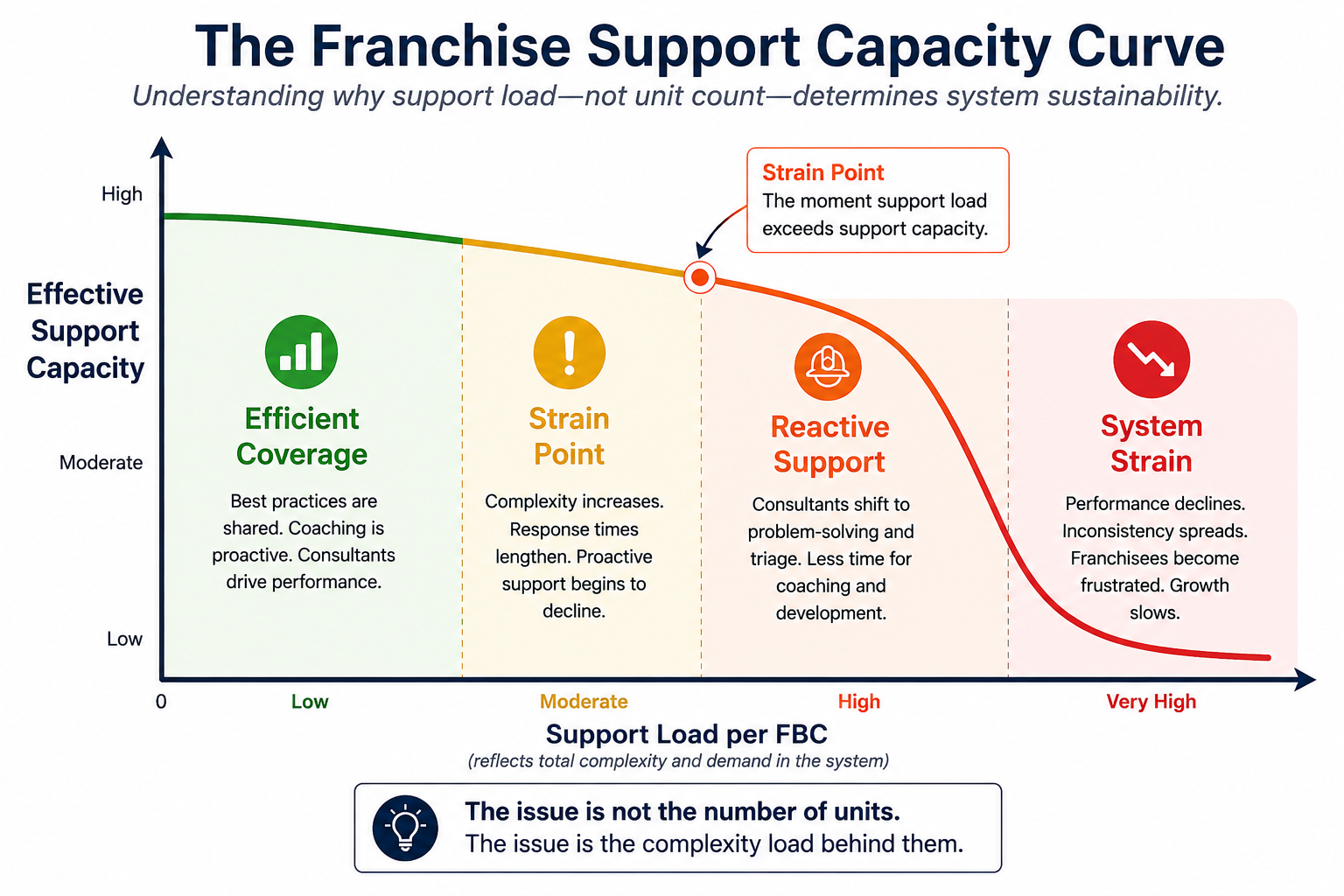
Figure 1. The Franchise Support Capacity Curve - Support capacity rarely declines because of unit count alone. As complexity compounds, support effectiveness eventually reaches a strain point where consultants shift from proactive coaching to reactive support. The tipping point is driven by support load—not simply the number of locations.
Complexity Creates Support Demand
The mistake isn't believing support matters.
The mistake is believing every location generates the same amount of support demand.
In reality, support demand is influenced by factors such as:
Franchisee experience and capability
New-unit concentration
Operational complexity
Geographic dispersion
Performance challenges
Growth velocity
Exception volume
Overall system maturity
Each factor increases the amount of time, attention, coordination, and expertise required to help franchisees succeed.
Two franchise systems with fifty locations can require dramatically different support organizations because their support loads are fundamentally different.
When Support Capacity Falls Behind
System strain occurs when support load grows faster than support capacity.
Everything that follows is simply the visible result of that imbalance: slower response times, inconsistent execution, consultant burnout, franchisee frustration, widening performance variation, and declining unit performance.
That moment rarely announces itself with a single catastrophic event.
Instead, it appears gradually.
Response times lengthen.
Coaching becomes reactive.
Field visits become less frequent.
Problems remain unresolved longer.
Operational inconsistency spreads.
Franchisees become frustrated.
Performance begins to vary more widely across the system.
Once support capacity is exceeded, Franchise Business Consultants stop acting like coaches and start acting like firefighters.
Instead of helping franchisees improve performance, they spend more of their time responding to urgent problems, resolving exceptions, and managing operational disruptions.
Franchisee performance declines.
Inconsistency spreads.
System strain compounds.
Many organizations respond by asking whether they need another FBC.
The better question is whether they truly understand the support demand their system is generating.
Because once support capacity is exceeded, adding another location doesn't simply add another location.
It amplifies the entire system.
A Better Question
Rather than asking:
How many locations can one Franchise Business Consultant support?
Growing franchise systems should ask:
How much support demand does our system actually generate?
That shifts the conversation from staffing ratios to system design.
A more accurate approach is to estimate total support demand across the system and then determine how many consultants are required to meet that demand.
Support planning should consider lifecycle stage, operational complexity, support hours per location, franchisee capability, geographic dispersion, and growth velocity before determining how many field resources are required.
The answer will rarely be found in a single ratio.
Final Thought
The 1:40 rule isn't the problem.
Treating it as a strategy is.
Rules of thumb have their place.
But they cannot replace an understanding of how complexity creates support demand.
Franchise systems don't fail because they choose the wrong support ratio.
They fail because they mistake location count for support load.
As franchise systems continue to scale, the brands that succeed will be the ones that stop measuring support by the number of locations and start measuring it by the complexity those locations create.
Because support capacity is not a staffing ratio.
It is a system design question.